Tamraght · Taghazout Bay · Morocco
You will do more than catch waves. You will learn how to surf them.
Morocco Surf Club is a small-group surf coaching operator in Tamraght, Taghazout Bay, near Agadir. Every session we run — beginner or intermediate — follows the same seven steps, and this page sets them out in full so you can judge the method before you pay for it. Groups are capped at 5 surfers per coach, because that cap is what makes step four possible at all.
The distinction that matters
A lesson teaches a skill once. Coaching runs a loop.
A surf lesson is a self-contained transaction: you are shown a pop-up, you try it, you go home. It works, and for a first-ever session it is exactly right. But nothing carries over — the next lesson starts from zero, often with a different instructor who has never seen you surf.
Coaching is the same seven steps repeated daily with the same coach, where Monday's correction is still being tracked on Friday. That continuity is the entire argument for a week rather than a lesson, and it is the reason progression is uneven — it compounds slowly, then moves.
The method
Seven steps, every session, in this order
Assess your level
The first session is watching, not teaching. The coach sees you paddle, take off and ride before deciding anything, because self-declared levels are unreliable in both directions — nervous surfers undersell, confident ones oversell, and the water settles it in twenty minutes.
Choose the right spot
Swell height and period, swell direction, wind, tide window, access, current, crowd, and the level of the guests booked that week. The bay holds sand beaches, reefs and right-hand points within a short drive, so there is usually an option that fits — and on the days there is not, that gets said out loud.
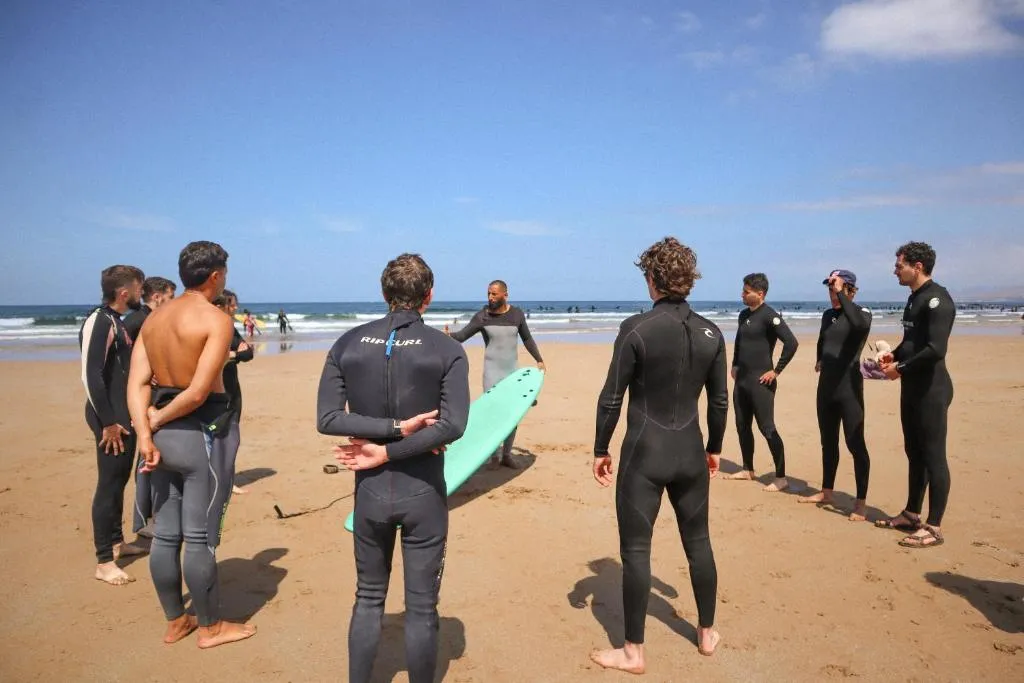
Brief it on the sand
Before anyone paddles: where the peak is, where the current runs, where to sit, where not to be, and the one specific thing you are working on this session. Two minutes on the beach saves twenty in the water.
Correct it in the water
The coach stays in the water with the group. A correction delivered between sets, while the wave you just blew is still fresh, changes the next attempt. The same correction delivered on the beach two hours later is a memory exercise.
Practise without being watched
Free-surf time follows the coached session. A movement that only appears while someone is watching is not yet a skill — repetition on your own is where it becomes automatic, and where you find out what you actually retained.
Review the footage
Video shows the gap between what a movement felt like and what it looked like. That gap is where most plateaus live, and it is close to impossible to describe someone out of it without showing them.
Set one goal for tomorrow
Every session ends with a single, specific goal for the next one. One correction at a time is what makes seven days compound instead of scatter — and it is why the coach on Friday still knows what you were told on Monday.
Step two, in detail
How the coach decides where you surf each morning
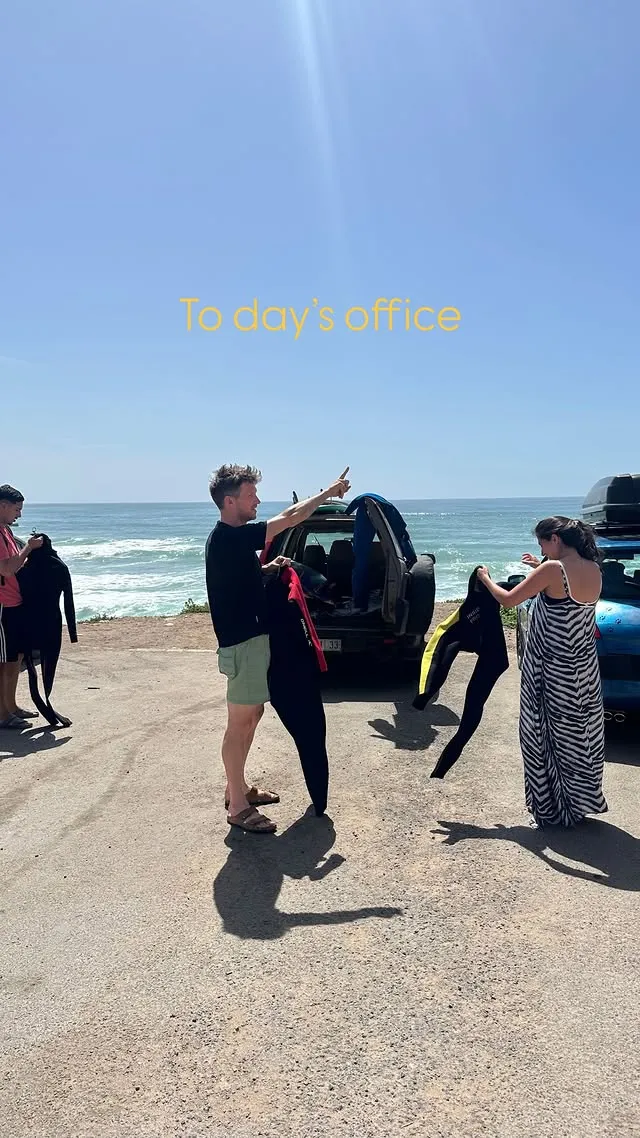
This is the part of a surf week you cannot buy from a board rental shop, so it is worth being explicit about it. Seven inputs are compared across the bay's options before the boards go on the roof.
| Input | Why it changes the answer |
|---|---|
| Swell height & period | Period tells you how much power arrives with the size. A small long-period swell can be heavier than a bigger short-period one. |
| Swell direction | Decides which breaks in the bay switch on. A W/NW swell wakes the northern points; the sand beaches take a wider range. |
| Wind direction & strength | Onshore wind ruins wave shape and makes learning harder. Mornings are usually cleaner than afternoons on this coast. |
| Tide window | Reefs and points work on specific tides. Sand-bottom beaches hold a wider window, which is why they are often the answer. |
| Access & current | How you get in and out, and what the water does between the peak and the beach — the single biggest safety input for a beginner. |
| Crowd | A technically perfect spot with forty surfers on it is the wrong spot for someone learning to choose waves. |
| The group’s level | The same conditions are a good day for one guest and an unsafe one for another. The group booked that week is part of the forecast. |
No camp can promise a named spot every day, and one that does is promising something the ocean does not supply. The breaks in rotation are Anza, Tamraght, Taghazout, Banana Point, La Source and Panoramas — see the Taghazout field guide for what each one is and who it suits.
The day it does not work
What happens when nothing suits your level
Some days the swell is too big for the group, the wind has flattened every option, or the only working break is beyond what a guest can safely handle. The session moves rather than being forced: a protected setup, a different tide window, or theory and video review on the sand with a shorter paddle when the water reopens.
Pushing a nervous surfer into a lineup beyond their level is the fastest way to lose a week to one bad experience, and it is not a trade worth making to keep a schedule intact.
Safety and travel cover
A named local coach, a beach check, and a clear plan
We take ocean safety seriously so you can focus on learning. The beach, board, group, and session length are chosen around the people and waves we have that day.
Know who is coaching you
We name the coach before you book. You can ask to see the available training and safety records before payment; a public outside verification link is not available yet.
Before anyone enters the water
We watch several sets, point out the safe area, currents, rocks, and the way back to shore, then change beach or plan when the conditions do not suit the group.
If something goes wrong
A first-aid kit travels with the group. The team knows how to contact local help and reach medical care in Agadir.
Bring travel insurance that covers surfing
Every guest needs personal travel insurance that includes surfing. We check the policy details when you arrive so you know what medical and activity cover you have.
Who runs it
A named coach, not a rotating instructor pool
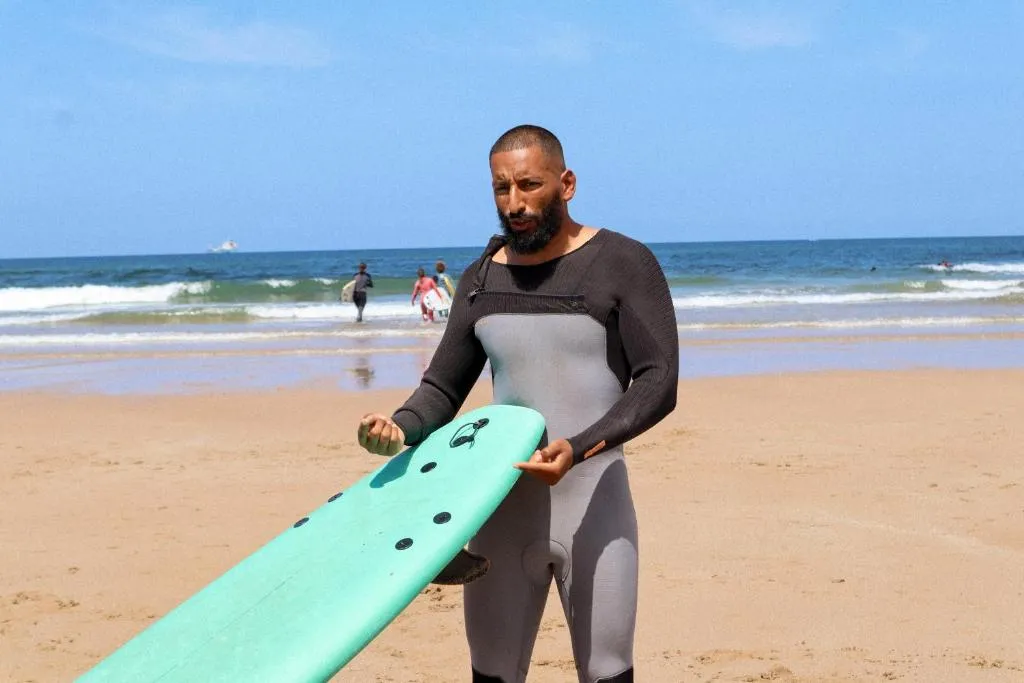
Jamal has coached in Taghazout Bay since 2014 and grew up surfing the points around Taghazout, Tamraght and Anza, in English, French, Arabic and Spanish. You know who is coaching you before you pay, and if a different coach will run your specific week we say so in the written quote. Meet the coaches →
Coaching questions
Surf coaching — your questions answered
How the sessions run, who watches you, and what happens when conditions do not cooperate.
How is coaching different from a surf lesson?
A lesson teaches you a skill once. Coaching runs a loop: assess the level, choose a spot that matches it, brief the specific thing you are working on, correct it in the water while it is happening, let you practise it unsupervised, review it on video, then set one goal for the next session. The same seven steps repeat daily so a correction from Monday is still being tracked on Friday.
How many surfers does one coach watch at a time?
Groups are capped at 5 surfers per coach. That cap is what makes in-water correction possible — beyond roughly five people in moving water, a coach is managing safety and headcount rather than watching individual takeoffs.
How does the coach decide where to surf each morning?
Swell height and period, swell direction, wind direction and strength, the tide window, access and current at each option, crowd, and the level of the guests booked that week. The bay holds enough variety — sand beaches, reefs, and right-hand points — that at least one option usually works, but a day where nothing suits the group is called honestly rather than forced.
What happens on a day the conditions do not suit my level?
The session moves rather than being cancelled by default: a protected setup, a different tide window, or theory and video review on the sand with a shorter paddle when the water reopens. Pushing a guest into a lineup beyond their level is the single fastest way to lose a week to a bad experience, so it is not a trade the coach makes.
Can I be coached without booking the whole week?
Yes — daily coached sessions run as a standalone product for guests already staying nearby. The seven-day structure exists because progression comes from repetition on consecutive days; a single session can fix one visible fault, but it cannot build the habit that makes the fix stick.
Next step
Let’s work on your next wave.
Tell us what you can already do in the water and what you keep getting stuck on. We reply with availability, an honest read on which week fits, and your total in euros before any deposit.
- Named coach
- Max 5 surfers / coach
- Quote before deposit
Check availability
Surf & Stay — from €360 / week
Tell us when you want to travel, who is coming, and how you surf. We check the room and coaching space before asking you to pay anything.
- 01Send your dates The form takes about two minutes.
- 02We check the fit Ismael replies personally with room availability and a written quote.
- 03Confirm securely If it works for you, we send a secure Stripe link for the 25% deposit.
Your booking is confirmed by email after the deposit. Read our booking & cancellation policy.
Where the information comes from
How this page was checked
Prices, inclusions, group size, operating history, and coach records come from Morocco Surf Club and describe our own service, not an outside review. We check safety, destination, and travel details against the official links below. You can ask to see the available coach records before payment while we work on a public verification link.
Last checked and updated . Conditions, transport, and entry rules can change, so confirm the latest details before travelling or paddling out.
- Agadir–Taghazout beach and surf overview Moroccan National Tourist Office
- ISA coaching and water-safety standards International Surfing Association
- Surfing safety checklist Royal National Lifeboat Institution