You do not need prior surf experience to surf in Morocco. Complete beginners can learn on suitable sand-bottom waves with coaching, while independent surfers can use the country’s point, reef, and beach options when their paddling, take-off, turning, etiquette, and exit skills match the day. Your real level is what you can do consistently—not the label you used when booking.
Surf level in Morocco means your demonstrated ability to manage a specific break under the day’s swell, wind, tide, current, and crowd. It is not a permanent badge. The same surfer can be independent on a small beach break, need coaching at a busy point, and be out of depth when the swell or entry changes.
That distinction protects both progression and safety. Morocco’s Atlantic coast has substantial variety: the Moroccan National Tourist Office reports more than 3,500 kilometres of coastline nationally and lists Taghazout among the country’s recognised surfing destinations (Moroccan National Tourist Office). Variety creates options, but it does not make every named wave suitable for every visitor.
Quick answer: match observable skills to support
Use this table before choosing a package. When you are between levels, book for the lower one and let consistent surfing—not optimism—justify moving up.
| Practical level | What you can currently do | Suitable support | Avoid until assessed |
|---|---|---|---|
| First-time beginner | Little or no surf-zone experience; learning board handling and pop-up | Coached lesson on forgiving white water with close supervision | Unsupervised sessions, rocky entries, crowded points |
| Developing beginner | Catches broken waves; pop-up is inconsistent; starting to angle | Daily coaching, stable board, sand-bottom wave, repeated feedback | Chasing smaller equipment or famous breaks |
| Early green-wave surfer | Occasionally catches unbroken waves; beginning to trim | Coaching on mellow peaks; positioning and wave-choice drills | Busy, fast points without reliable control |
| Improving intermediate | Paddles out independently; takes off both ways; basic turns and etiquette | Coaching or hybrid coaching/guiding | Breaks whose entry, power, or crowd exceeds experience |
| Independent advanced surfer | Reads line-ups, manages entries and exits, controls speed and turns in power | Local guiding and condition knowledge | Assuming any spot is safe because of ability |
The right question is therefore not “Am I intermediate?” It is “What can I repeat without physical assistance, and under what conditions?” If you want a broad destination overview first, open the surf Morocco planning hub. If you already know you need foundations, the beginner surf camp guide explains the coaching pathway.
Level 1: complete beginner and first waves
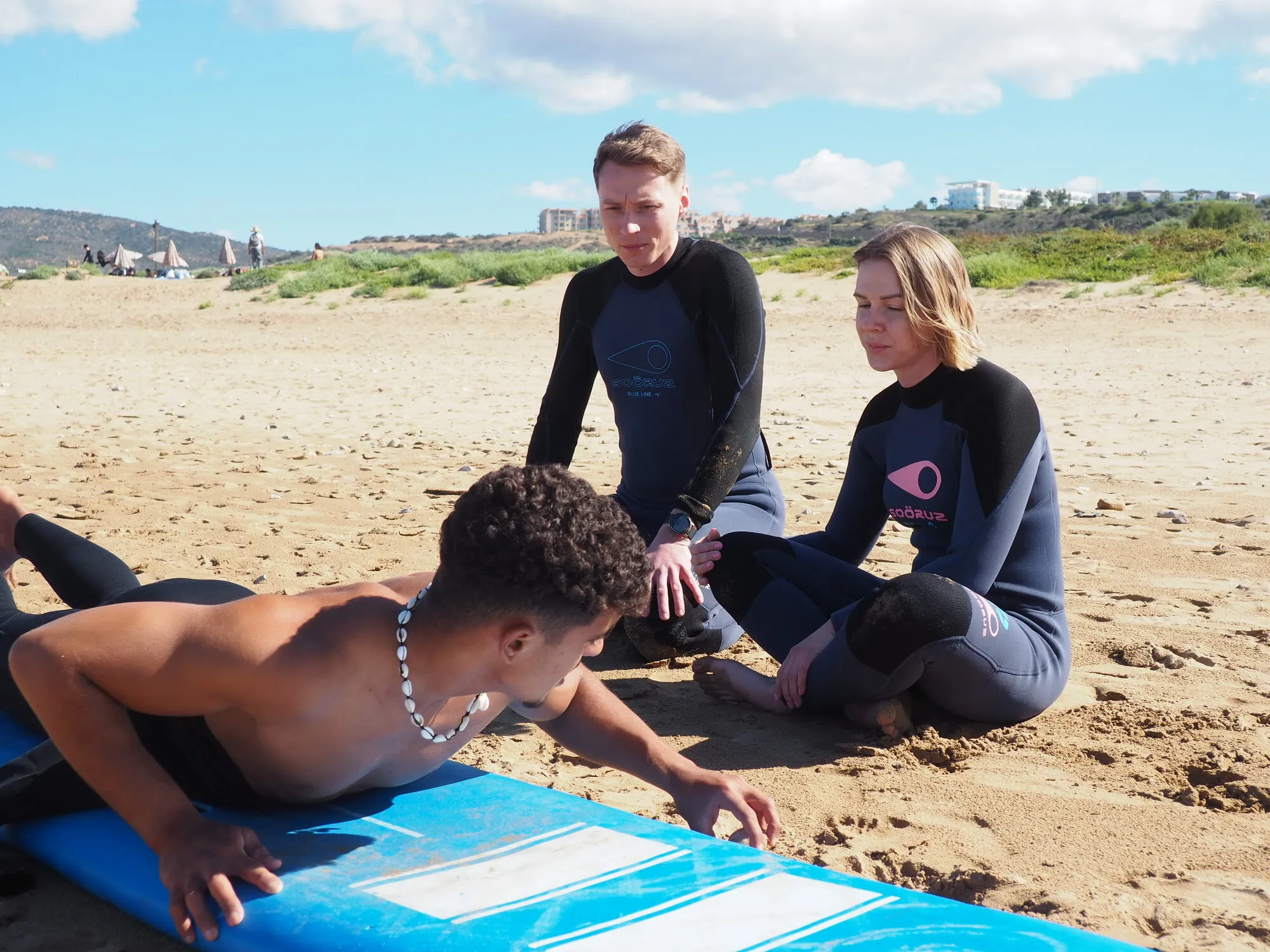
A complete beginner has not yet built a safe routine around a moving board. The first objective is not standing at any cost. It is learning where to position the board, how to protect the head, how to fall away from equipment, how to identify the lesson boundary, and how to respond to the coach. Standing becomes useful when it sits inside that routine.
Appropriate first sessions usually use stable equipment and a forgiving area selected after checking conditions. “Sand bottom” lowers one category of consequence; it does not remove currents, collisions, shorebreak, or other people. The lesson should begin with a beach briefing and a narrow technical goal.
The International Surfing Association’s introductory instructing course treats safety, risk management, beginner equipment, coaching methods, skill development, and programme planning as separate modules. The eight-module introduction is only the first step toward its Level 1 instructor certification, according to the ISA (International Surfing Association). When an operator advertises “ISA,” ask for the named coach’s actual credential instead of assuming that attendance at any course means full certification.
Swimming comfort matters. A learner may begin in waist-deep white water, but an ocean lesson still happens among broken waves and moving water. Be specific: can you swim continuously, float calmly, put your face in the water, and recover after being knocked over? Disclose respiratory, cardiac, injury, pregnancy, medication, or panic concerns. The operator must assess the actual setting, while health questions may require advice from an appropriate clinician.
Level 2: developing beginner
Developing beginners have experienced the basic sequence but cannot yet reproduce it reliably. They may catch white-water waves alone, then lose stability when asked to angle. They may stand in a lesson but struggle to choose safe waves or return to the starting area.
This stage benefits most from repetition with the same coach. The goal is to remove wasted movement: better prone position, a stronger paddle rhythm, hands placed consistently, feet landing in a usable stance, eyes looking where the board should go, and a controlled finish. Changing five things at once makes it hard to know what worked.
A larger, stable board often creates more successful repetitions. Moving immediately to a short board because it looks advanced can reduce wave count and hide whether the pop-up is improving. Board choice should reflect body size, fitness, the wave, and the task; litres alone are not a complete prescription.
Developing beginners should also learn line-up etiquette before entering a mixed peak. That includes waiting for space, not dropping in on the surfer with priority, controlling the board rather than abandoning it, and avoiding a paddle path through the riding line. A coach should choose an area where these lessons can happen without placing the group inside a crowded expert take-off zone.
Our week-at-camp field guide shows how that repetition builds across seven days. The core value is continuity: the coach can see whether yesterday’s correction remains available when fatigue, a new peak, or a different board adds pressure.
Level 3: early green-wave surfer
An early green-wave surfer can sometimes catch an unbroken wave but still relies on favourable positioning or a coach’s call. Typical priorities are paddle timing, looking over the shoulder before committing, angling the board, matching the wave’s speed, and holding a trim line.
This level is often overestimated because one successful ride is memorable. Use consistency instead: out of ten suitable opportunities, how many do you identify, catch, stand on, and direct without a push? Can you recognise a closeout? Can you stop or kick out without sending the board into somebody else? Can you return to the peak while avoiding the riding line?
Taghazout’s reputation does not require you to surf its most photographed points. Morocco’s tourism office describes the Agadir-Taghazout area as offering varied waves for different abilities, but separately characterises Anchor Point and Killer Point in relation to experienced surfers (Moroccan National Tourist Office). The sensible interpretation is not “every level can surf every spot”; it is “the wider area offers choices when somebody knowledgeable matches the spot to the surfer.”
Mellow unbroken waves with a channel or straightforward paddle can help an early green-wave surfer build independence. Even then, current, period, tide, wind, crowd, and bottom contour change the demand. A spot name is not a safety rating.
Level 4: improving intermediate
An improving intermediate can paddle out, position, catch waves without a push, take off in both directions, hold a line, perform basic turns, and follow priority rules in familiar conditions. The weaknesses appear when the wave is faster, the entry is rocky, the crowd is assertive, or the current makes position hard to maintain.
At this stage, choose between coaching and guiding based on the purpose of the trip:
| Choose coaching when… | Choose guiding when… |
|---|---|
| You want a technique diagnosis and structured drills | You already execute fundamentals without physical help |
| Your take-off, stance, or turning breaks down repeatedly | Your main gap is local access, tide, and condition knowledge |
| You need video tied to a precise correction | You can assess and decline waves responsibly |
| You are returning after a long break or injury | You can manage entries, exits, current, and etiquette |
A hybrid week can work well: coaching on the first days, then more independent surfing if the assessment supports it. The decision should remain reversible. If swell rises or fatigue changes control, returning to a mellower break is intelligent trip management, not demotion.
For regional context, our Taghazout surf guide explains why points and beaches demand different decisions. The best Morocco surf spots guide is organised around level and conditions, so you can compare options without treating a list as permission to paddle out.
Level 5: independent and advanced surfers
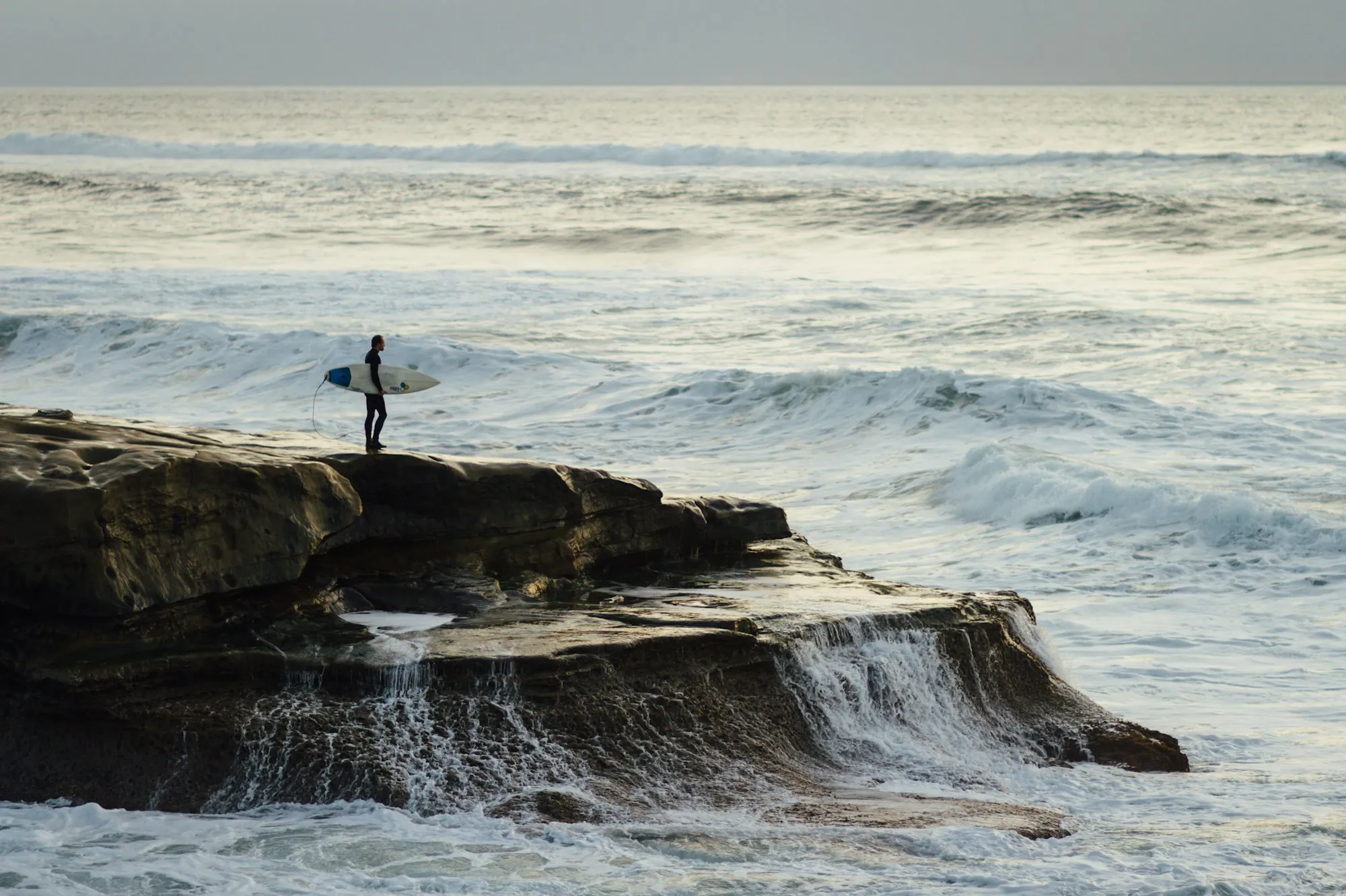
Advanced ability increases the range of possible waves; it does not remove local risk. A competent visitor still needs information about access, rocks, current, tide sensitivity, local use of the line-up, emergency options, and how a swell direction changes the break. Local guiding can be valuable precisely because the surfer does not need basic technique instruction.
Independent means you can plan the entire session: inspect from land, identify hazards, choose equipment, enter, position, follow priority, control the board, exit, and change the plan when the assumptions are wrong. It also means you can say no before the paddle-out.
The US National Weather Service explains that rip currents can occur on apparently calm days and that long-period swell can increase transport of water through the surf zone. Its safety guidance says to check conditions, avoid swimming alone, use lifeguarded areas where available, and assume currents may be present even when they are difficult to see (NOAA National Weather Service). Morocco has different local services and beaches, but the physical principle reinforces why surface appearance alone is not a complete assessment.
Do not delegate the final decision to a guide, app, or forecast. Ask what the group will do if size, wind, crowd, or entry is outside your comfort. A professional response includes a realistic alternative, not pressure to preserve the day’s marketing promise.
Why the season changes the level match
Morocco is surfed across the year, but “surfable” and “appropriate for me today” are different claims. Stronger Atlantic swell can activate points and raise consequences, while smaller periods may favour learners or require more exposed locations. Wind and local shelter change the usable window. No seasonal chart guarantees a particular size on your travel dates.
For beginners, the operator’s option set matters more than a slogan such as “beginner season.” Ask whether the coach can change beach, time, board, or session format when the planned location is unsuitable. For independent surfers, seasonal probability helps choose dates, but the short-range forecast and observations at the break still control the session.
Use the best time to surf Morocco guide for the broader seasons, or the Taghazout month-by-month planning table to compare travel windows for your level.
Ready to surf in Morocco? Check your current skills
Write your answers down and send them to the camp. Specifics let the operator recommend coaching, guiding, or a mixed format.
- Water confidence: How long can you swim and float calmly? Have you been comfortable in surf-zone turbulence?
- Recent frequency: How many sessions have you surfed in the past three months, not across your lifetime?
- Wave independence: Can you identify, catch, and ride an unbroken wave without a push or call?
- Direction and control: Can you take off left and right, hold a line, turn deliberately, and stop safely?
- Paddle and access: Can you negotiate white water, maintain position in current, and manage a non-beach entry and exit?
- Etiquette: Can you identify priority and avoid obstructing a surfer already riding?
- Limits: What conditions make you leave the water, and have you acted on that limit before?
If you cannot answer a question, say so. Honest uncertainty is more useful than selecting “intermediate” from a form. Share injuries, relevant health constraints, approximate height and weight for equipment, and whether fear—not technique—is the main barrier.
How to check whether a camp really matches your level
Ask these questions before paying:
- Who is the named coach or guide, and what qualification do they hold?
- What is the maximum surfer-to-coach ratio in the water?
- Which observable skills separate beginner coaching from guiding?
- How are the spot and session time chosen?
- What happens when conditions exceed the group’s ability?
- Are board, wetsuit, daily transport, meals, and accommodation included?
- Will advanced and first-time surfers share one coach and one peak?
- Are price, room, deposit, cancellation terms, and add-ons confirmed in writing?
At Morocco Surf Club, the published seven-night Surf & Stay week includes six surf days with a two-hour class each and caps coaching groups at five. Surf Guiding is positioned for surfers who already paddle out independently. Those are first-party package facts, not an industry standard; compare them with the details in your own written quote on the surf camp page.
A briefing you can copy and send to your coach
Copy this into your booking message and replace the blanks:
My last session was … at … . I used a … board in … conditions. I caught waves with / without a push. I can usually go left / right / straight in white water / unbroken waves. I need help with … . I feel comfortable in … and leave the water when … . My dates are … and my goal is … . Would coaching or guiding fit?
If you have a short video from a recent session, offer to share it. Include a typical attempt rather than only your best ride; a coach can learn from the paddle, timing and finish as well as the standing section. A video still cannot establish swimming ability or readiness for unfamiliar conditions.
Three examples help interpret the answer:
- “I stood up in ten lessons, but the instructor pushed me.” Start with coaching. Independent wave selection and catching are still learning goals.
- “I catch green waves on a familiar beach, but avoid crowds and rocks.” Ask for progression coaching or a carefully matched local introduction. A point-break guiding trip is not an automatic next step.
- “I enter, catch, turn and exit independently, but don’t know this coast.” Discuss guiding and disclose the size, current and access conditions you usually manage.
For first-timers booking in French, our surf camp débutant au Maroc explains equipment, first-session expectations and the questions to send before arrival. For everyone, keep the description current: a long break from surfing may change the support you need.
For a first coached week, see our beginner surf camp in Morocco. If you already catch unbroken waves and want to improve your turns and wave selection, the intermediate surf camp in Morocco explains the entry skills and coaching focus.
Choose the support, not the label
Morocco works for first-timers, progressing surfers, and experienced visitors because the coast offers varied wave types and local operators can move between options. The useful booking decision is the level of support: close beginner instruction, progression coaching, hybrid coaching, or independent guiding.
Describe what you can do repeatedly, disclose your limits, and ask how the operator changes the plan. If you want a full week of structured practice, continue to what a Taghazout surf camp week actually includes. If you are ready to request dates, send your present level—not your aspirational one—through the camp booking section.
Frequently asked questions
Can a complete beginner surf in Morocco?
Yes. A complete beginner can learn in Morocco when a qualified coach chooses a forgiving beach, supplies appropriate equipment, teaches safety before technique, and keeps the group manageable. Morocco has advanced points as well as beginner-friendly options, so suitability comes from the day’s spot and conditions—not from the country or town name alone.
Do I need to be a strong swimmer to take a surf lesson?
You should tell the operator exactly how comfortable you are in moving water before booking. Beginner lessons may start in shallow white water, but surf zones contain currents, broken waves, and moving equipment. A coach must decide whether the location and supervision are appropriate; a lesson is not a substitute for basic swimming ability or medical clearance.
When am I ready to surf Taghazout point breaks?
You are ready for a particular point only when you can paddle efficiently, negotiate the entry and exit, take off with control, hold a direction, follow priority rules, and return without depending on a rescue. The answer changes with swell, tide, crowd, and current, so past success elsewhere does not automatically make today’s point suitable.
Is Anchor Point suitable for beginner surfers?
No. Anchor Point should not be treated as a beginner teaching wave. The Moroccan National Tourist Office associates it with experienced surfers, and its rock entry, current, crowd, speed, and consequence can demand independent skills. A beginner can enjoy the Taghazout area without surfing its famous point by using condition-appropriate sand-bottom alternatives with coaching.
Should an intermediate surfer book coaching or surf guiding?
Choose coaching if you want technique diagnosis, structured drills, and feedback. Choose guiding if you already manage paddle-outs, positioning, priority, take-offs, turns, and exits independently and mainly need local condition and access knowledge. If one of those fundamentals is inconsistent, a coached or hybrid week is usually more useful than pure guiding.
What is the best season for my surf level in Morocco?
There is no month that guarantees the right wave, but different seasonal patterns change the probability and range of options. Beginners need manageable conditions and a coach with alternative beaches, while advanced surfers often seek stronger Atlantic swell. Use a month-by-month guide, then confirm the short-range forecast and level match close to the session.
Sources and verification
These references support the destination and planning information above. Live forecasts and prices can change; confirm package details in your written quote. Article updated 2026-10-08.