A week at a Taghazout surf camp should give you seven days of structured practice, not seven identical beach trips. Expect early condition checks, a clear goal for each coached session, equipment and spot choices matched to your level, and enough recovery to keep learning. The useful outcome is better judgment and repeatable technique—not a guaranteed turn, barrel, or “perfect wave.”
A Taghazout surf camp week is a coached progression block based around Taghazout Bay, usually with accommodation, daily transport, equipment, and planned water time. Its value comes from continuity: the coach sees yesterday’s problem, chooses today’s task, and adjusts tomorrow’s location. It is different from buying unrelated lessons from a different instructor each day.
This guide explains the rhythm we use from our Tamraght base. It also separates our published inclusions from the general questions you should ask any operator. For exact prices and availability, use the current seven-day surf camp page; the article is about the learning experience, not a promise that every week follows the same swell or timetable.
The seven-day rhythm at a glance
The week has a progression arc, but the ocean decides the clock. Wind, swell direction, period, tide, crowding, and the group’s energy can all change the spot or session order. Treat the table as a decision framework rather than a rigid itinerary.
| Stage | Main purpose | Typical coaching focus | Honest expectation |
|---|---|---|---|
| Arrival | Establish context | Equipment check, goals, health and experience | No pressure to surf after travel |
| Days 1–2 | Build a baseline | Safety, stance, pop-up, position, wave choice | Coach identifies the highest-value correction |
| Days 3–4 | Add repetition | Timing, trim, paddle efficiency, independent decisions | Fatigue often appears and volume may need adjusting |
| Days 5–6 | Apply the skill | Reading a new peak, linking actions, video review | More responsibility moves to the surfer |
| Day 7 | Consolidate | Repeatable routine and next-step plan | Clearer judgment matters more than a highlight clip |
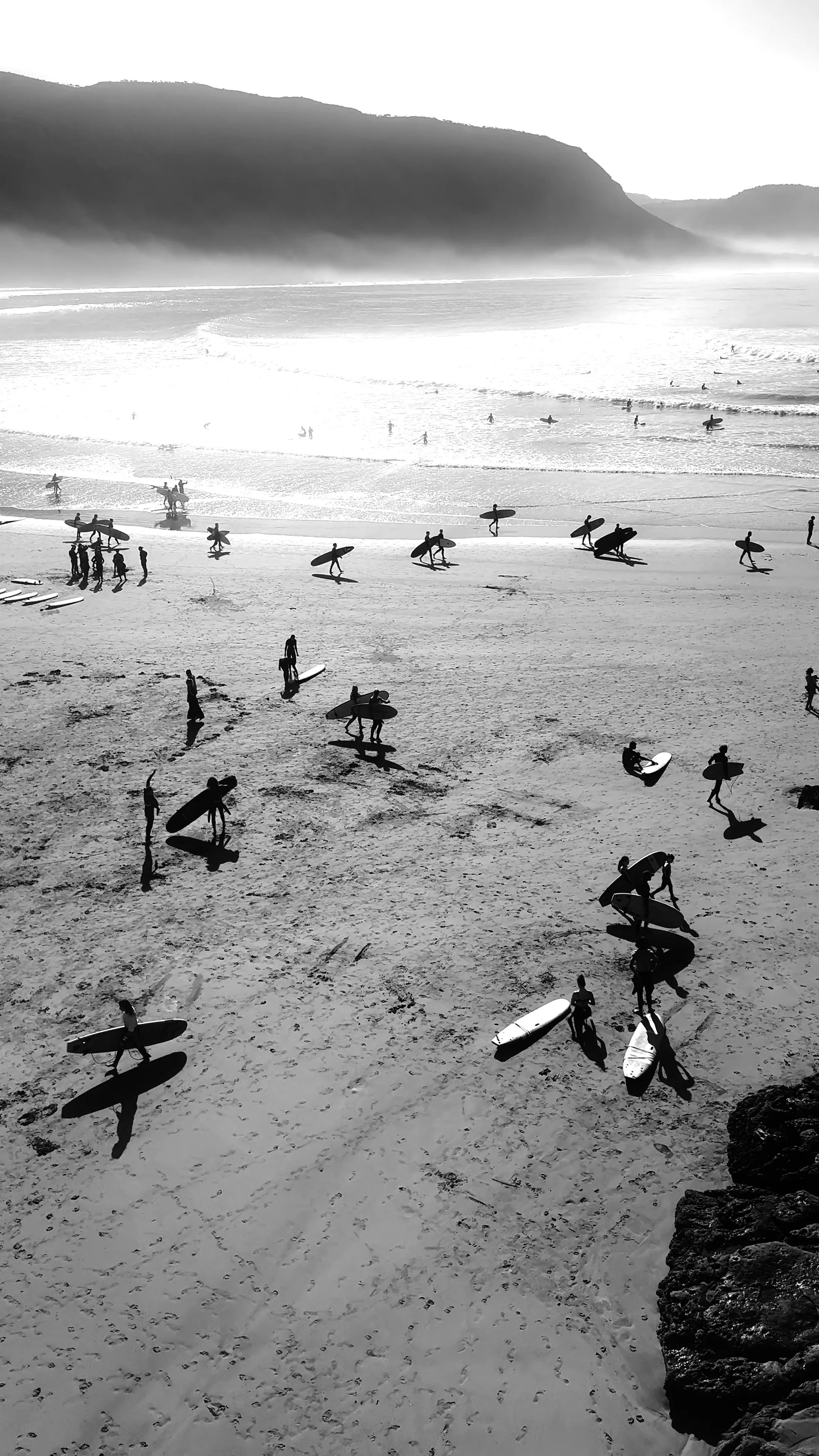
Morocco’s National Tourist Office describes Taghazout as a world-known surf area with a variety of waves for different levels, and notes that the resort’s beach extends for about seven kilometres. Variety is the advantage: it gives a local coach options. It does not mean that every break is appropriate for everybody. The same official guide identifies Anchor Point and Killer Point with experienced surfers in mind, which is why a beginner itinerary should not be built around ticking off famous names (Moroccan National Tourist Office).
Before day one: arrival, goals, and honest disclosure
Arrive expecting a conversation before a performance. Tell the coach when you last surfed, what board you used, whether you can swim comfortably in moving water, what injuries affect you, and what normally causes fear. “Intermediate” means different things to different people; a description of observable skills is much more useful.
We ask about paddling, unbroken-wave take-offs, directional control, turning, and previous experience getting through white water. Our separate Morocco surf level guide gives a practical self-assessment. If you are still deciding between a coached beginner week and guiding, compare the inclusion and ability notes on surf camp Taghazout.
Travel fatigue is also real information. Flying, sitting, missed sleep, dehydration, and an unfamiliar bed can reduce coordination. A quiet arrival evening, food, water, and an equipment check are often a better investment than forcing a late session. A camp that promises an immediate surf regardless of light or conditions is placing the itinerary above judgment.
For our published Surf & Stay package, the stable first-party facts are seven nights, six surf days with a two-hour class each, transport to the selected spot, board and wetsuit, and video analysis. The current group cap is five surfers per coach. Those figures are specific to Morocco Surf Club and were checked on 5 August 2026; always read your written quote because room choices, airport transport, peak dates, and package tiers can change the total.
Days one and two: build the baseline
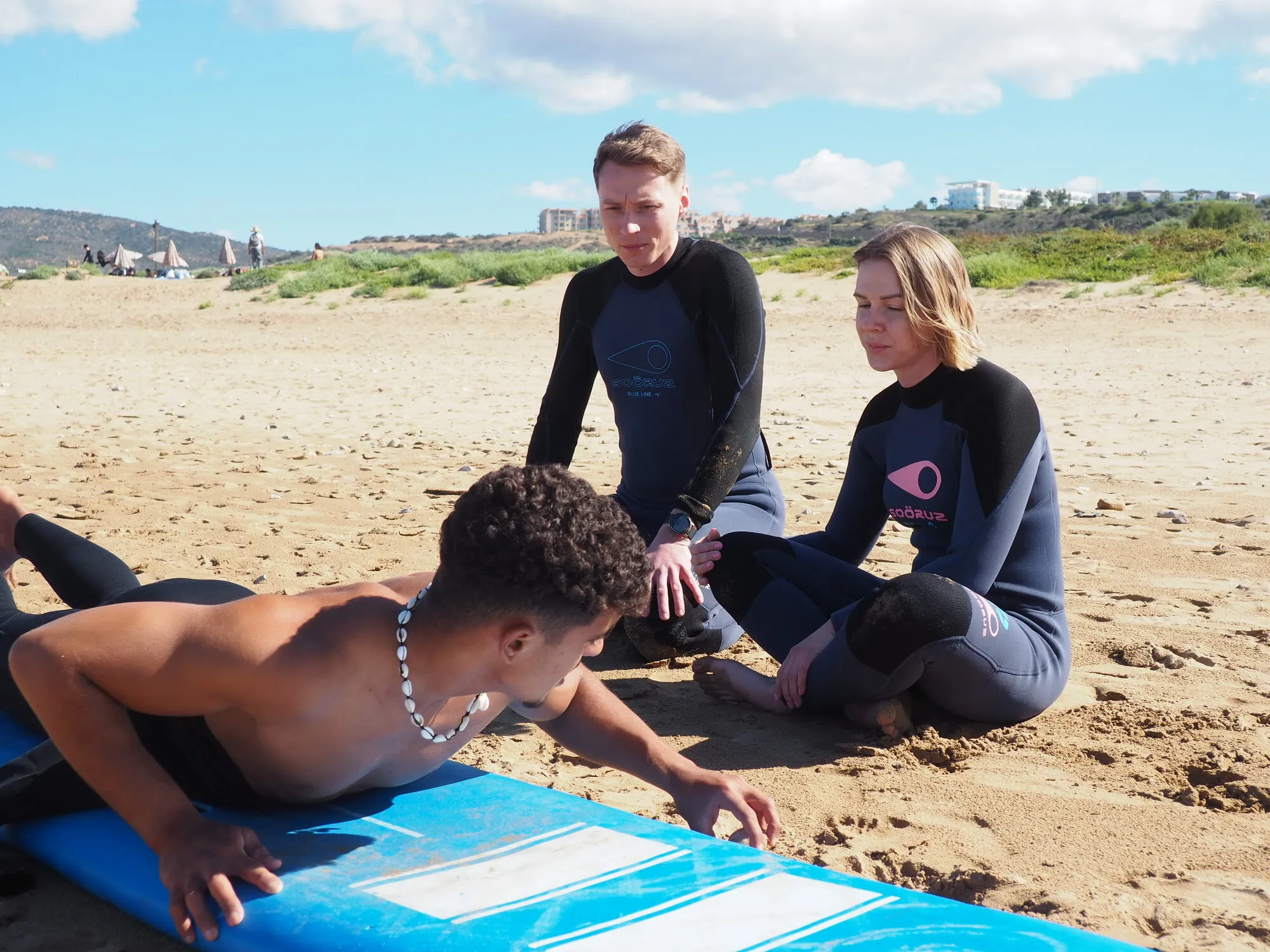
The first session answers a simple question: what should this surfer practise next? For a first-timer, that may be safe board handling, prone position, a stable pop-up, and finishing a white-water ride without jumping into shallow water. For an early green-wave surfer, it may be identifying a catchable shoulder, angling the take-off, or looking along the line instead of at the board.
Good beginner instruction includes safety and risk management, not only technique. The International Surfing Association’s introductory instructor pathway explicitly includes modules on safety guidelines, risk management, beginner equipment, coaching methods, skill development, and programme planning. Its online introduction contains eight modules and is described as the first step—not, by itself, a full instructor certification (International Surfing Association). That distinction is useful when checking vague claims about “ISA training.” Ask exactly what qualification a named coach holds and request evidence before payment if certification matters to your decision.
A warm-up should prepare the movement you will use: shoulders, upper back, hips, ankles, and a few controlled pop-ups. The session goal should remain narrow enough to remember in moving water. “Surf better” is not a coaching cue. “Hands under the chest, front foot between the hands, eyes toward the open face” is something a surfer can test on the next wave.
The coach may change your board. More volume can help a learner catch waves and stabilise the first stand, while a smaller board can make a skilled surfer more manoeuvrable. Neither is a status symbol. Equipment is a tool for the session’s objective, and the right choice can change as the week progresses.
Days three and four: repetition meets fatigue
Midweek is where a camp becomes more valuable than isolated lessons. The coach now has evidence: which cue worked, which error returns under pressure, how quickly you tire, and whether you can transfer the skill from white water to an unbroken wave. Repetition becomes deliberate instead of random.
It is also when shoulders, lower back, hips, ribs, or neck may feel the accumulated load. New surfers often tense through paddling and stand-ups, using more energy than the movement requires. The answer is not automatically another long session. It may be fewer waves with more feedback, a more forgiving break, a larger board, a slower warm-up, or rest.
Hydration and sun protection belong in the learning plan because discomfort and fatigue affect attention. The World Health Organization recommends sun protection when the UV Index reaches 3 or above. Its guidance prioritises limiting midday exposure, seeking shade, protective clothing, a broad-brimmed hat, sunglasses, and broad-spectrum sunscreen on skin that cannot be covered (World Health Organization). Check the day’s local UV forecast rather than assuming cloud or wind removes the risk.
Midweek video is useful when it answers one question. A short clip can show that a surfer’s feet land together, the chest rises too early, or the eyes stay down. Watching twenty undirected clips over dinner is entertainment, not analysis. The coach should connect what you see to one change you can feel in the next session.
Days five and six: transfer responsibility to the surfer
Later in the week, progression should include decisions made without being pushed into every wave. Can you identify the peak? Can you leave space for another surfer? Can you recognise when you are too far inside? Can you choose a wave that suits the task rather than chase the largest set?
This is where Taghazout Bay’s variety matters. A move between breaks tests whether the skill survives a different entry, current, peak, or wave shape. But variety must stay subordinate to suitability. Our guide to surfing Taghazout explains the local point-and-beach context, while the best surf spots in Morocco guide groups locations by ability rather than treating them as a bucket list.
Rip-current knowledge is part of independent judgment. The US National Weather Service defines a rip current as a narrow flow moving away from shore and advises checking conditions, speaking to lifeguards where present, never swimming alone, and not assuming calm-looking water is safe. If caught in a rip, its guidance is to stay calm, avoid fighting directly against the current, move parallel to shore when possible, and signal for help if unable to escape (NOAA National Weather Service). This is general education, not a substitute for the briefing at the actual beach.
The strongest late-week outcome may be saying “not today.” Declining a crowded point, a difficult entry, or a wave outside your ability is evidence of progress. A coach should support that decision, offer an appropriate alternative when possible, and never use group pressure as a safety system.
Day seven: measure progress without pretending
Learning is rarely a straight line. One guest may stand on the first morning and struggle on the fourth. Another may need three sessions to become calm, then improve quickly. Conditions can make the final day look less impressive even when the surfer’s positioning and decisions are better.
Use observable outcomes:
- Can you set up and carry the board safely?
- Can you identify the day’s hazards and the agreed surfing area?
- Is your pop-up more repeatable when tired?
- Can you select an appropriate wave instead of accepting every push?
- Can you trim or hold a chosen direction on a suitable unbroken wave?
- Do you know when to stop, move peak, change equipment, or ask for help?
Some guests will finish with independent green-wave rides; others will consolidate white-water skills. Both can be valid outcomes. Seven days does not turn every beginner into an unsupervised surfer, and no ethical camp can guarantee a skill that depends on health, conditions, learning rate, and judgment.
Before leaving, ask for a next-session plan: suitable wave type, useful board range, one technical focus, one safety focus, and the conditions in which you should still seek coaching. That turns the week into a foundation rather than a holiday memory.
What is included—and what you must confirm
“Surf camp” is not a standardised package. Compare written inclusions, not hero images.
| Question | Why it matters | Morocco Surf Club’s published Surf & Stay week |
|---|---|---|
| Who coaches? | Continuity affects feedback | Named lead-coach information is published |
| Maximum group size? | Determines observation and water management | Maximum five surfers per coach |
| Session length? | “Daily surfing” can mean different things | Six surf days, two-hour class each |
| Equipment? | Rental can change the true cost | Board and wetsuit included |
| Spot transport? | The suitable wave may not be walkable | Daily spot transport included |
| Meals and room? | Packages vary widely | Breakfast, four dinners, and selected room tier |
| Airport transfer? | It may be an add-on | Confirmed in the written quote |
| Cancellation terms? | Ocean and travel plans change | Read the booking policy before deposit |
The current entry price is shown on the surf camp booking page, not frozen in this article. Ask for dates, room type, package tier, airport add-ons, inclusions, exclusions, deposit, and cancellation terms in one written quote. You can also review the site’s booking policy before committing.
What should you pack for seven surf days?
Pack for sun, early starts, salt water, and recovery. Bring secure swimwear, a water bottle, high-SPF broad-spectrum sunscreen, protective lip balm, sunglasses, a hat, a towel or changing robe, and warm layers for mornings and evenings. If you use prescription medication, bring enough for the trip and keep essential doses in your hand luggage.
If you bring a board, confirm airline rules, transfer capacity, and storage before departure. Pack spare fins appropriate to the boxes, a fin key, leash, wax for the expected water temperature, and a small repair option. If you rent, send your height, approximate weight, ability, and preferred board in advance, but remain open to a coach choosing a different tool for progression.
Do not treat this list as medical advice. If an injury, heart or respiratory condition, pregnancy, medication, or prior panic in open water could affect surfing, speak to an appropriate clinician and disclose relevant limitations to the operator. A camp needs accurate information to plan; it does not replace professional healthcare.
The practical next step
First, decide whether you need beginner coaching or independent guiding. Then send your dates, a skills-based description of your level, and the one outcome you care about most. Read the written inclusion list and terms before paying. If our capped-group format matches what you need, see current camp details and availability; if season is the open question, use the canonical month-by-month Morocco surf season guide.
Frequently asked questions
What happens during a week at a Taghazout surf camp?
A well-run week combines coached water sessions on most days, condition-based spot choice, equipment, recovery time, and review. At Morocco Surf Club, the published Surf & Stay week lasts seven nights, includes six surf days with a two-hour class each and one rest day, and caps coaching groups at five so the session goal can be adjusted to each surfer.
Is seven days enough to learn to surf?
Seven days is enough for many beginners to build repeatable foundations, but it does not guarantee independent surfing. A realistic outcome is better positioning, a more consistent pop-up, basic wave selection, and safer decisions. Progress depends on fitness, conditions, fear response, previous board-sport experience, sleep, and how well the session matches the learner.
Do Taghazout surf camps surf at Anchor Point every day?
No. Anchor Point is an advanced point break and is not a default teaching beach. The right location changes with swell, wind, tide, crowd, and ability. Beginners usually benefit from forgiving sand-bottom waves, while independent surfers may use points only when the conditions and their paddle, take-off, turning, and exit skills genuinely match.
What should I pack for a Morocco surf camp week?
Bring secure swimwear, a reusable water bottle, high-SPF broad-spectrum sunscreen, a hat, sunglasses, a towel, warm layers for early starts, and any personal medication. A small repair kit is useful if you bring your own board. Confirm whether the camp supplies a wetsuit, board, transport, meals, and airport transfers before paying.
How tiring is a seven-day surf camp?
Expect accumulated shoulder, back, and hip fatigue by the middle of the week, especially if surfing is new to you. Good coaching manages volume rather than treating exhaustion as a badge of honour. Sleep, hydration, food, warm-ups, shorter sessions, and an honest rest day can protect technique and decision quality when fatigue rises.
How do I choose a trustworthy Taghazout surf camp?
Ask for the named coach, maximum group size, session duration, included equipment, transport, accommodation details, cancellation terms, and the process for changing spots or cancelling water time when conditions are unsuitable. A trustworthy operator answers in writing, avoids guaranteeing waves or progress, and matches the plan to your present ability rather than the most famous break.
Sources and verification
These references support the destination and planning information above. Live forecasts and prices can change; confirm package details in your written quote. Article updated 2026-10-08.