The Taghazout surf season offers possibilities throughout the year. Experienced surfers chasing Atlantic point waves usually look first at late autumn and winter; beginners should prioritise mobile coaching and manageable daily conditions, with spring and early autumn useful starting points. Choose a month for the kind of trip you want, then let the short-range forecast and beach assessment determine the surfing.
A surf season is a broad pattern in swell and weather, not a forecast for an individual holiday. A famous winter month can deliver unsuitable conditions for a learner; a quieter summer week may offer useful first lessons without producing the point waves an experienced traveller hoped for.
This guide focuses on the Taghazout Bay area. For a broader destination comparison, see the best time to surf Morocco. If you are not sure whether you need coaching or guiding, begin with the surf-level checklist.
Taghazout surf season by month: a practical planning table
Read adjacent months as gradual transitions. These are qualitative planning tendencies, not measured probabilities or safety classifications. Holidays and a single large swell can change the crowd and usable conditions within any month.
| Month | Broad seasonal context | If you are learning | If you surf independently |
|---|---|---|---|
| January | Main winter swell period | Ask how lessons move when exposed beaches are too powerful | Keep room for large-swell days outside your limits |
| February | Winter swell remains a major consideration | Choose daily spot assessment over a fixed beach itinerary | Discuss entries and exits before targeting a point |
| March | Transition out of winter | Plan for variable size rather than assuming gentle surf | Allow for both stronger pulses and quieter days |
| April | Spring transition | Useful month to discuss a coached progression trip | Bring realistic expectations about point-wave consistency |
| May | Toward the smaller summer pattern | Prioritise catchable waves and flexible session times | Consider whether a mixed surf-and-holiday trip fits |
| June | Summer pattern emerging | Ask about options when waves are weak or wind affected | Do not book solely around famous winter points |
| July | Summer; less dependable point surf | A first lesson may fit, but small does not always mean useful | Build a trip you will enjoy without premium surf |
| August | Summer and holiday travel | Confirm room availability and actual coaching group cap | Separate holiday crowds from surf-line-up conditions |
| September | Transition toward autumn | Discuss both water confidence and flexible beach choice | Treat returning swell as possible, not scheduled |
| October | Autumn transition toward winter | Choose an operator able to respond to rising swell | Leave daily choices open until the forecast develops |
| November | Main swell season approaching | Ask about sheltered alternatives and programme changes | Local knowledge matters as more powerful pulses arrive |
| December | Winter swell plus holiday demand | Confirm both supervision and holiday booking terms | Avoid assuming every winter day offers clean points |
For the full package and the way transport supports daily spot choice, see our Taghazout surf camp. A flexible location plan is more useful than selecting a month purely from an attractive photograph.
What the guide can tell you before flights are booked
There are three different planning decisions. First choose the broad season. Then choose a camp or accommodation whose format matches your level. Finally, choose individual sessions from the actual conditions. Do not use evidence for one decision as a guarantee about the others.
The Moroccan National Tourist Office describes the area’s range of surf and its well-known points. That supports the case for varied local options, not a promise that every guest can use every break. Our monthly table is an editorial interpretation of seasonal trade-offs, rather than a measured weather dataset.
The Anchor Point forecast and Windfinder’s Taghazout forecast help with the later decision: checking swell, wind and tide near the trip. A forecast for one exposed point does not describe the exact size of a beginner’s teaching zone elsewhere in the bay.
If dates are fixed by school holidays or leave, start with that constraint. Tell the coach your actual skills and what would make the holiday worthwhile if some water sessions need to change. If dates are flexible, compare two seasonal windows with the same room, travel and coaching requirements before buying flights.
Winter: maximum opportunity, maximum need for judgment
From November through February, North Atlantic storm activity raises the probability of organised, long-period swell reaching Morocco. That is the season behind Taghazout’s reputation for right-hand points. It also increases the chance that a famous exposed wave is powerful, crowded, difficult to enter, or simply irrelevant to a learning objective.
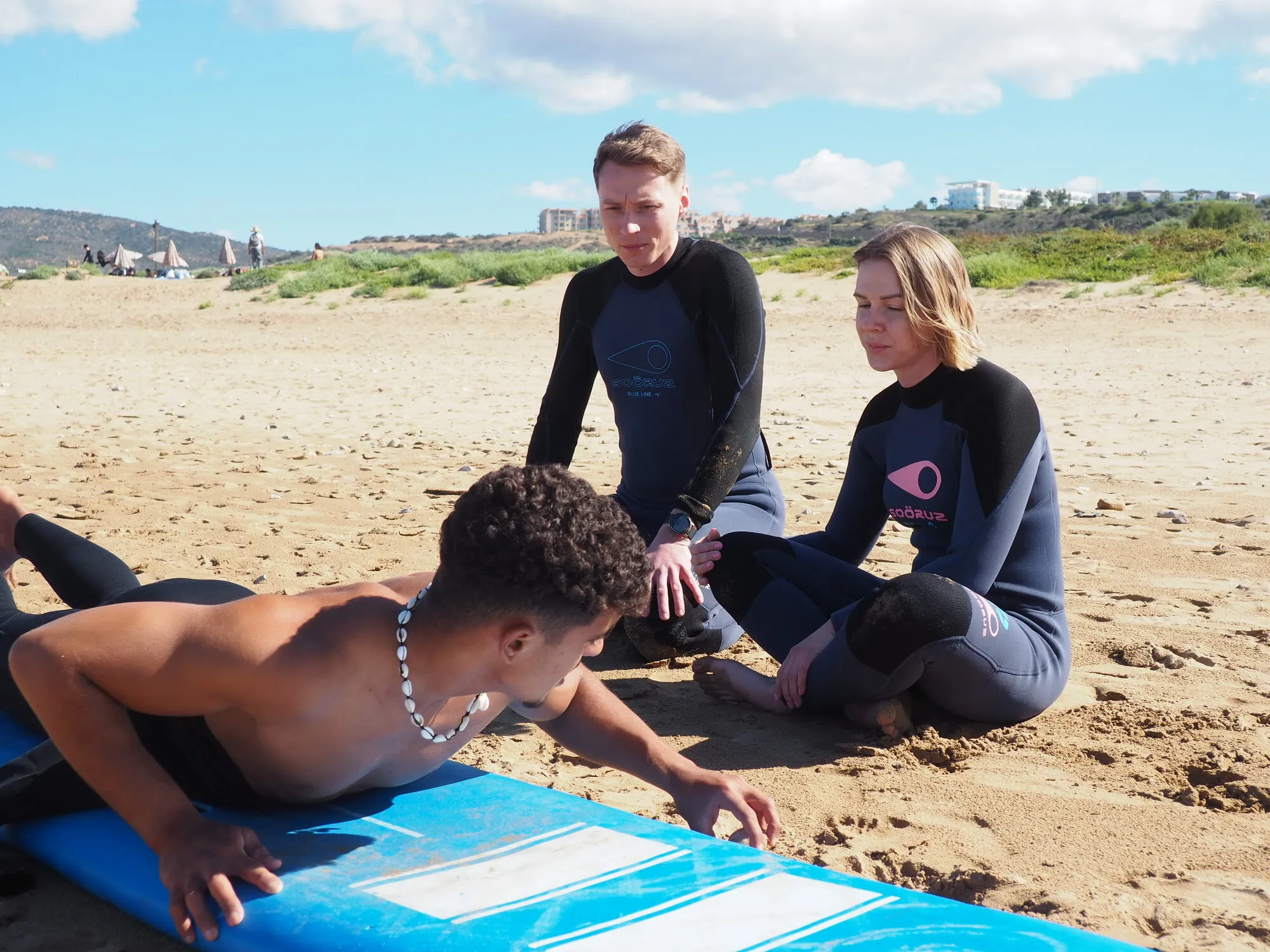
For experienced surfers, the appeal is clear: more days when points can connect and a wider chance of meaningful surf. For beginners, winter is not automatically “closed.” A mobile coach can search for protection, smaller reform waves, or a sand-bottom zone whose depth and current fit the group. But the coach needs alternatives, transport and the authority to cancel or shorten the water session.
The practical winter question is not “Will there be waves?” It is “How does the operator respond when the obvious beach is too large?” Ask which areas can offer protection, how groups are separated by level, and whether the quote allows a safety-led programme change. Our beginner surf camp guide explains why outcomes cannot be guaranteed even within a seven-day block.
Peak swell can concentrate capable surfers where the best-known waves work; holidays can add accommodation demand too. A busy line-up changes the technical demand. A surfer who handles the wave itself may still struggle to position, communicate and follow priority among a dense pack. Crowd belongs in the decision, not as an afterthought.
Spring: the broadest coaching trade-off
March through May is a transition. The probability of major winter swell tends to ease, while useful pulses still arrive. For many progressing surfers, that creates the broadest coaching trade-off: enough energy to practise direction and trimming on suitable days without organising the entire trip around powerful point surf.
April is a reasonable starting point for a conversation about a coached spring trip. That does not mean April 14 is safer or better than January 14. Ask how the coach accommodates different levels and whether the daily programme can move when the forecast changes.
Wind risk starts to matter more as the season advances. An early clean window may deteriorate by afternoon even when swell height appears unchanged. Travellers who value instruction should be willing to move breakfast or transport around the usable window rather than demand a fixed 10:00 lesson. A daily timetable is convenient; a condition-led timetable is more honest.
May can appeal to learners while offering less dependable point-wave conditions for an experienced partner. That distinction matters for couples or groups with different goals. A complete beginner may value softer repetitions, while an independent partner could find fewer days that activate the classic points. Mixed groups should discuss which outcome has priority before choosing the month.
Summer: warm atmosphere, narrower surf margin
June through August generally shifts the planning emphasis toward smaller swell and finding useful wind windows. There can still be surf. Smaller pulses and exposed beaches may produce appropriate sessions, especially early in the day. But a week chosen only because “summer is beginner season” can disappoint if the surf is too weak, short-period or wind-affected to provide enough catchable waves.
Smaller conditions do not automatically make a better lesson. Learning needs manageability and opportunity. Flat or crumbling conditions can help a first water-confidence session but limit progress toward green waves. The coach may focus on paddling, board control and white-water repetition rather than chase a milestone the ocean is not offering.
August overlaps wider holiday travel and can bring busy village life even when surf is small. The pressure may differ from a winter point crowd: more beach users, more beginner groups, more transport and more demand for accommodation. Ask for the exact room and group cap in writing rather than assuming a low-swell month means an empty bay.
Summer suits travellers whose trip remains valuable without premium surf: warm-weather time, a first lesson, food, village rhythm and day trips. Our things to do in Taghazout guide helps build that broader itinerary. If high-quality point surf is the primary reason for the flight, summer carries more seasonal risk.
Autumn: returning swell and wide level potential
September and October bridge summer and the main swell season. They are worth considering for groups balancing different surfing goals. The change is not tied to the first day of a calendar month: ask about the developing forecast and keep beach choice flexible.
November shifts toward winter. Stronger Atlantic systems can create more options for capable surfers while making exposed beaches less suitable for learners. A coached learner can still have an excellent week, but the operator’s mobility becomes more important. Independent surfers should also avoid assuming the first major pulse will arrive cleanly: direction, period and local wind still decide whether a particular point connects.
September can suit a beginner who wants warmth with a growing chance of useful swell. The timing of returning swell can be irregular. If you book far ahead, decide whether you value reliable warmth, stronger surf probability, or a compromise; the month cannot optimise all three.
How to turn a month into a session decision
Seasonal planning ends once the short-range forecast becomes useful. A responsible sequence is:
- Choose a month by level and trip priorities. Choose which trade-off matters most to the people travelling.
- Review the trend about a week before arrival. Look at swell height, period, direction and wind—not height alone.
- Compare the tide window. A break can change depth, speed, access and current through the same day.
- Inspect the actual beach. Crowd, sand movement, local access and shorebreak are not fully represented by a forecast tile.
- Match one learning objective. The best session is the one that offers manageable repetitions for today’s skill.
- Keep an alternative. Moving, shortening or cancelling can be the correct decision.
Our companion spot-and-tide decision matrix explains the six inputs in more detail. It should be read as a framework for asking better questions, never as remote permission to enter a break.
Two booking examples and a fallback plan
A first-timer and an independent partner travelling together: start by separating coaching needs from accommodation. The learner needs instruction and a manageable zone; the partner may want local guiding and a different break. Ask whether separate groups are available on your dates and whether you will still share meals and transport. Do not assume one coach can supervise both at distant peaks.
An independent surfer with one fixed summer week: decide whether a small-wave trip will still satisfy you. If it will, confirm suitable equipment, keep mornings flexible and plan recovery time and non-surf activities. If your only goal is a powerful point wave, consider changing the travel window before paying for non-refundable flights. No operator can book a swell for you.
For either trip, ask about four practical consequences before paying: what happens when the planned beach is unsuitable, whether transport alternatives are included, how a shortened or cancelled session is handled, and which parts of the booking can be changed. Get the answers in the written terms rather than infer them from a general seasonal description.
A week does not need every hour filled. Leave a free afternoon after demanding sessions and a margin before your airport transfer. Our things to do in Taghazout guide can help with the non-surf part, while the complete week budget keeps optional activities separate from the camp quote.
Update, 9 September 2026: the earlier numerical monthly ratings have been replaced with a qualitative table. There is no verified local dataset behind a month-by-month safety or success percentage, so the revised guide avoids implying that precision. Use it to narrow dates, then ask a coach about your level, the forecast and alternatives.
Frequently asked questions
What is the best month to surf Taghazout?
There is no single best month for every surfer. Late autumn and winter generally appeal to experienced surfers seeking North Atlantic swell, while spring and early autumn are useful starting points for many coached beginners. A monthly tendency never replaces the short-range forecast or the coach’s beach assessment.
Can beginners surf Taghazout in winter?
Yes, when an experienced coach can move the lesson to a sheltered, manageable zone and the day’s depth, current, shorebreak and crowd fit the learner. Winter raises the probability of powerful swell at exposed points; it does not make every beach too large. The available alternatives matter more than the month label alone.
Is there surf in Taghazout during summer?
Yes, but summer generally has smaller, shorter-period and less consistent Atlantic swell than the main winter season, with afternoon wind often becoming a larger planning constraint. Small conditions can suit first sessions, although very weak surf can also reduce useful wave count. Confirm the forecast rather than treating summer as guaranteed beginner perfection.
Is this monthly guide based on measured surf probabilities?
No. This is a qualitative planning guide, not a statistical model. Public destination and forecast sources help explain the broad seasons, while the checklist translates them into booking questions. It does not assign numerical safety ratings, predicted wave counts or percentage chances to a month; local observations decide whether a session is suitable.
How far ahead can I trust a Taghazout surf forecast?
Use seasonal data to choose a broad month, then recheck forecast trends roughly a week before arrival and make the final spot decision on the day. Forecast uncertainty grows with lead time, and local wind, tide, sand movement, access and crowd can change whether a predicted swell produces a useful session at a particular break.
Sources and verification
These references support the destination and planning information above. Live forecasts and prices can change; confirm package details in your written quote. Article updated 2026-09-09.