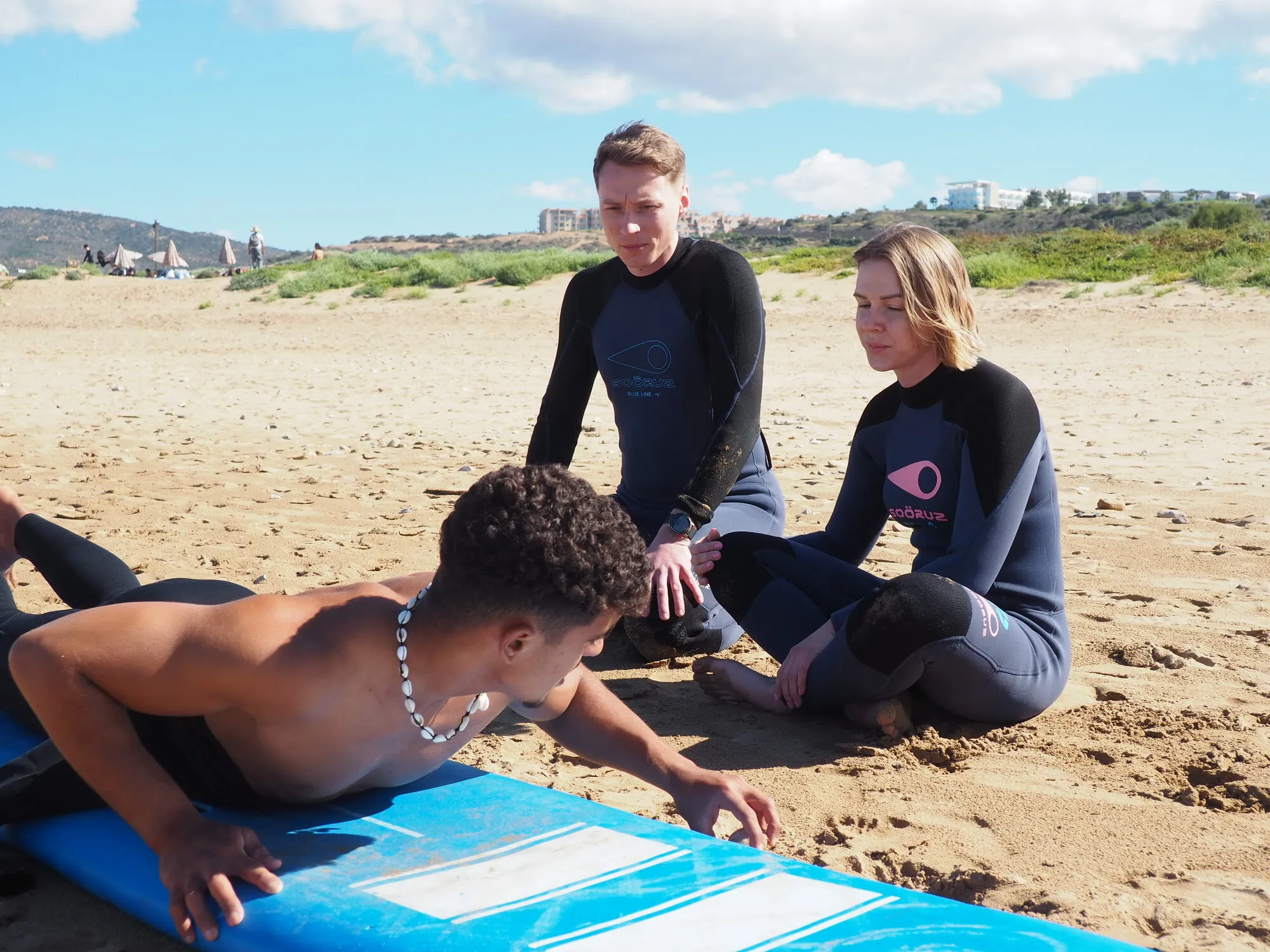
A useful Taghazout spot and tide guide must compare six inputs together: swell height and direction, swell period, tide, wind, crowd and surfer level. Choosing a break from one green forecast tile is not enough. This matrix shows how a coach turns forecast data into questions, then uses an in-person beach check to accept, change or cancel the plan.
The Taghazout Spot–Tide Matrix is a six-input decision framework for screening possible sessions before an on-site assessment. It is not a live recommendation, hazard map, rescue plan or claim that a named spot will work within a fixed numerical range. Sand, access, current and crowds change; the matrix exists to make uncertainty visible.
Morocco Surf Club first published this framework on 31 August 2026. It converts the condition-led language used across our surf Taghazout guide into a reproducible sequence. For season selection rather than a single session, use the month-by-month Taghazout planning guide.
The six-input matrix at a glance
The table describes what each input can change and the question it should trigger. It intentionally avoids universal “best” numbers. A 1.2-metre swell at eight seconds is not equivalent to 1.2 metres at sixteen seconds, and neither tells you the breaking-wave height at a particular bank without direction, tide and local exposure.
| Input | What it changes | Beginner question | Independent-surfer question | Stop or move signal |
|---|---|---|---|---|
| Swell height + direction | Exposure, wrap, breaking size and which zones receive energy | Is there a protected, repeatable white-water zone? | Which points receive the angle without closing out? | Observed size or direction differs materially from plan |
| Period | Energy, set spacing, wrap and possible current | Are set waves too powerful for controlled repetition? | Will long-period sets amplify the entry or inside current? | Long lulls hide sets beyond the group’s ability |
| Tide | Depth, speed, current, shorebreak, reef cover and access | Is the teaching area deep enough without strong shorebreak? | Is the entry/exit usable through the session window? | Depth, rocks or exit deteriorate faster than expected |
| Wind | Surface quality, board control and drift | Can learners control boards and hear instructions? | Is the wind helping shape or destroying the chosen wave? | Onshore gusts or drift compromise control |
| Crowd | Collision risk, wave count and decision pressure | Is there enough space for supervised repetitions? | Can the surfer position and follow priority confidently? | Group cannot maintain a safe teaching boundary |
| Level + fatigue | Paddle capacity, reactions, judgment and recovery | Can the learner repeat today’s objective calmly? | Can the surfer manage this entry, power and line-up now? | Ability observed today is below the assumed level |
The matrix is a filter. It can eliminate unsuitable options; it cannot certify safety. The final choice requires an actual view of the water, local access knowledge, a clear emergency plan and the willingness to say no.
Input one: swell height and direction
Forecast swell height usually describes offshore significant swell, not the exact face height a surfer will meet at the take-off. Bathymetry, headlands, reefs, sandbanks and direction transform that energy. Two breaks a short drive apart can react differently to the same offshore reading.
Direction controls exposure. The Taghazout area is famous for points that respond to North Atlantic energy, but “northwest” is still a range rather than a switch. A more northerly angle may wrap into one point while missing a beach behind shelter; a more westerly component can expose zones that were smaller the day before. The live break guide from Surf-Forecast presents swell and wind conditions alongside the local Anchor Point context, which is more useful than height alone (Surf-Forecast).
For a beginner group, the first question is whether the energy creates a controlled learning zone, not whether the points are working. White water needs enough consistency for repetition but not so much force that learners lose board control or spend the session recovering. If the selected beach is too exposed, a mobile programme should inspect protection elsewhere.
For an independent surfer, direction also affects crowd distribution. When only one famous point receives the angle cleanly, surfers concentrate there. A slightly less perfect wave with more space may produce more useful rides and better risk management than the obvious name.
Input two: period changes the meaning of height
Period is measured in seconds between swell crests. Longer-period swell has travelled farther and is often more organised. It can carry more energy, wrap into points and produce stronger currents than a shorter-period swell displaying the same height. This is why “only one metre” can be a misleading reassurance.
Set spacing matters psychologically and operationally. Long lulls can make a break look manageable during a five-minute check, then reveal much larger sets. A proper inspection should last long enough to observe several cycles, include the horizon, and identify where caught-inside surfers move.
For coaching, period affects the distance and timing between repetitions. Short-period surf can produce frequent broken waves but also disorder and limited recovery. Long-period surf can offer cleaner lines but increase consequence. Neither is automatically better; the learning objective and zone decide.
Never turn a period threshold into a universal rule. Local seabed, swell direction and tide alter the result. Use period to increase or decrease caution, then verify the observed wave. When the sets reaching the beach do not match the assumption, the observation wins.
Input three: tide is a moving condition, not a label
“Low,” “mid” and “high” compress a continuous change. Tide alters water depth over reef and sand, the shape and speed of the wave, current pathways, shorebreak and the physical entry or exit. A session that starts in a usable window can become unsuitable before it ends.
Windfinder publishes tide state alongside wind and wave data for Taghazout, which is useful for timing an inspection (Windfinder). But the app does not know whether recent sand movement created a steep shorebreak at the exact teaching bank. A coach must compare the predicted state with what the shoreline is doing.
For beginners, “sand bottom” is often presented as a complete safety answer. It is not. Shallow water can make board and body impact more likely; a rising tide can change current and available white water; a high tide can create a heavy shorebreak at some beaches. The relevant question is whether depth, current, wave shape and space remain manageable for the whole supervised period.
For points and reefs, tide may change rock exposure and exit routes. The group needs a latest exit time, not just a start time. If the route becomes more difficult, the session should finish early enough to leave with a margin.
Input four: wind controls more than wave appearance
Offshore wind can groom the face, but strong offshore wind can also hold surfers up in the lip, make paddling out harder or push boards away after a fall. Onshore wind can reduce surface quality, create drift and make a learner’s board harder to control. Crosswind can move a group along the beach and weaken the coach’s ability to keep a clear boundary.
Morning sessions are common because local wind may be lighter before daytime heating changes the pattern. That is a tendency, not a guarantee. A fixed daily lesson time sacrifices one of the main advantages of local coaching if the useful window shifts.
The coaching question is audible control: can guests hear the briefing, keep hold of boards and remain within the agreed zone? The performance question for an independent surfer is secondary. Clean faces are attractive, but the session still needs a workable entry, current and exit.
Wind forecasts also carry uncertainty. Compare more than one update and watch the actual texture on the water, flags, spray and moving sand. When observed gusts contradict the model, do not wait in the impact zone for the app to become correct.
Input five: crowd is a physical condition
Crowd changes the wave even when the ocean does not. More surfers reduce opportunities, increase collision paths and require faster priority decisions. A beginner can become tense and stop applying a technical cue; an independent visitor can paddle aggressively and make poor choices after missing sets.
Morocco’s National Tourist Office presents Taghazout as a globally recognised surf destination with celebrated breaks, which helps explain why the best-known points attract attention (Moroccan National Tourist Office). Popularity is not a criticism; it is an input to manage.
For lessons, establish a visible boundary away from the main riding line. If the group cannot maintain space, move. “The forecast was perfect here” does not justify placing learners among boards travelling at speed.
For independent surfers, etiquette is part of ability. Local norms, priority, waiting position and respect for regular users matter. More wave count at a less famous break can be better coaching and better surfing than a crowded bucket-list session.
Input six: level and fatigue complete the decision
A surfer’s level is dynamic. Travel, poor sleep, cold, fear, a sore shoulder or several consecutive sessions can reduce paddle power and reaction time. The break that fitted on day two may not fit on day six even under similar conditions.
Use observable skills. Can the surfer control the board, paddle through broken waves, identify priority, take off without a push, hold direction and exit independently? Our skills-based Morocco surf level guide replaces labels such as “intermediate” with actions a coach can assess.
For beginners, confidence is not bravado. A calm learner who follows instructions may progress better than a fit guest who panics after the first set. For independent surfers, prior success at another point does not prove readiness for this entry, crowd or power.
The stop signal is mismatch between assumed and observed ability. Change the board, reduce the objective, move zone, shorten the session or stay out. Preserving a marketing itinerary is not a reason to ignore new evidence.
A worked example: why one green tile is not enough
Imagine a forecast showing 1.2 metres from the northwest, a medium-to-long period, light morning offshore wind and a rising mid tide. A simplistic app might mark the morning green. The matrix produces questions instead:
| Matrix step | Beginner group | Independent intermediate |
|---|---|---|
| Height + direction | Inspect whether a protected white-water zone receives manageable energy | Check whether a point wraps cleanly without exceeding comfort |
| Period | Observe multiple set cycles; do not judge during a lull | Expect more energy and current than height alone suggests |
| Tide | Confirm depth and shorebreak through the session window | Confirm entry and exit remain usable on the rise |
| Wind | Start while control and communication remain good | Use the clean window but retain an exit margin |
| Crowd | Move if teaching space disappears | Compare wave quality with actual opportunity and etiquette |
| Level | Keep one repeatable skill goal | Decline if paddle or positioning is not reliable today |
The output could be two different beaches or no session for one group. That is not inconsistency. It is the purpose of matching a spot to people instead of matching people to a forecast score.
Rip currents and the limit of remote planning
Rip currents can appear where breaking waves move water toward shore and that water returns seaward through a narrower path. NOAA’s safety guidance advises checking conditions, using lifeguarded areas where available, never swimming alone and not assuming calm-looking water is safe. If caught, it recommends staying calm, not fighting directly against the current, moving parallel to shore when possible and signalling for help when unable to escape (NOAA National Weather Service).
That general guidance is educational, not a local rescue plan. Services, signs and beach conditions in Morocco vary. Before entering, identify who is supervising, the session boundary, the exit, the signal to return and what the group will do if separated.
A photo, camera or app cannot reliably reveal every current. The final inspection needs time and local judgment. If uncertainty remains high, choose the more conservative option.
Taghazout spot tide guide: a reusable beach protocol
Use this sequence from a safe viewpoint before unloading equipment. Do not impose a five-minute limit: a short lull can hide larger sets.
- Watch several complete set cycles, including the largest visible set.
- Identify entries, exits, current paths, shorebreak and exposed obstacles.
- Compare actual wind and wave direction with the forecast assumption.
- Count people and observe how the line-up uses priority.
- Define the session boundary and one technical objective.
- Set a time to reassess tide, wind, fatigue and crowd.
- Name the alternative before entering.
Record the decision after the session: chosen zone, inputs, what differed from forecast and why you stayed, moved or stopped. Over time, that creates real first-party data. Record what you actually saw separately from the forecast so the next session starts with useful observations.
For commercial terms and the five-person cap, use the surf camp package and inclusions. For location choices around Tamraght, Taghazout village and Anza, read surf camp Taghazout. The matrix should make the final answer more conditional, not falsely certain.
Keep a session decision sheet
Use one row per check and ask the coach to explain any mismatch. This is a discussion and observation aid; it is not a self-certification of safety or permission to surf without suitable supervision.
| Check | Write down before entering | Reassess when… |
|---|---|---|
| Forecast context | Date, local time, source, swell height, direction and period | A new update or arriving set differs from the plan |
| Tide window | Tide stage at the start and expected stage at the finish | Shorebreak, depth or the planned exit changes |
| Actual water | Largest observed sets, current, obstacles and people | Drift increases, sets grow or teaching space disappears |
| Group objective | One skill, agreed boundary, coach’s signal and who is supervising | Fatigue, confidence or control changes |
| Decision | Stay out, inspect an alternative, or follow the coach’s session plan | Any important assumption stops being true |
Download the blank session decision sheet to keep in your phone notes. Fill in the location precisely: “Taghazout” is too broad to identify a particular teaching zone or exit. Include the local time and date, since an observation from yesterday is not an assessment for today.
After the session, add what changed and why the plan held or changed. A useful note is “we moved when the teaching boundary became crowded,” rather than “the spot was good.” It gives you a specific question for tomorrow and helps distinguish improvements in your own control from a day with easier conditions.
Frequently asked questions
Which tide is best for surfing Taghazout?
No single tide is best for every Taghazout break. Tide changes depth, speed, current, entry and the way a wave meets reef or sand. Start with a break-specific range, then inspect the actual water and move if the observed conditions do not match the group. A tide label alone is not a safety decision.
Which swell direction works best in Taghazout?
Northwest to north-northwest swell is the classic window for many Taghazout points, while more westerly swell can expose a broader set of breaks. Direction must be read with period and size: the same height can produce very different energy and wrapping behaviour. Local observation remains essential.
Is a sand-bottom Taghazout spot safe for beginners?
A sand bottom can reduce reef contact but does not make a spot automatically safe. Shorebreak, current, water depth, crowd, board collisions and changing sandbanks remain relevant. A beginner zone is suitable only when the full six-input check and an in-person coach assessment fit the learner’s demonstrated ability.
Can I choose a Taghazout surf spot from an app?
An app can supply useful swell, wind and tide inputs, but it cannot fully show access, crowd behaviour, local sand movement, the exact shorebreak or a surfer’s fatigue. Use apps to form hypotheses, then verify from land and ask local professionals. Never treat a remote forecast as permission to enter the water.
Why does swell period matter as much as height?
Period is the time between swell crests and is a proxy for how organised and energetic a swell may be. Longer-period energy can wrap into points, feel more powerful and increase currents even when the listed height looks modest. Height, period and direction must be interpreted together, not as independent traffic lights.
Sources and verification
These references support the destination and planning information above. Live forecasts and prices can change; confirm package details in your written quote. Article updated 2026-09-09.